

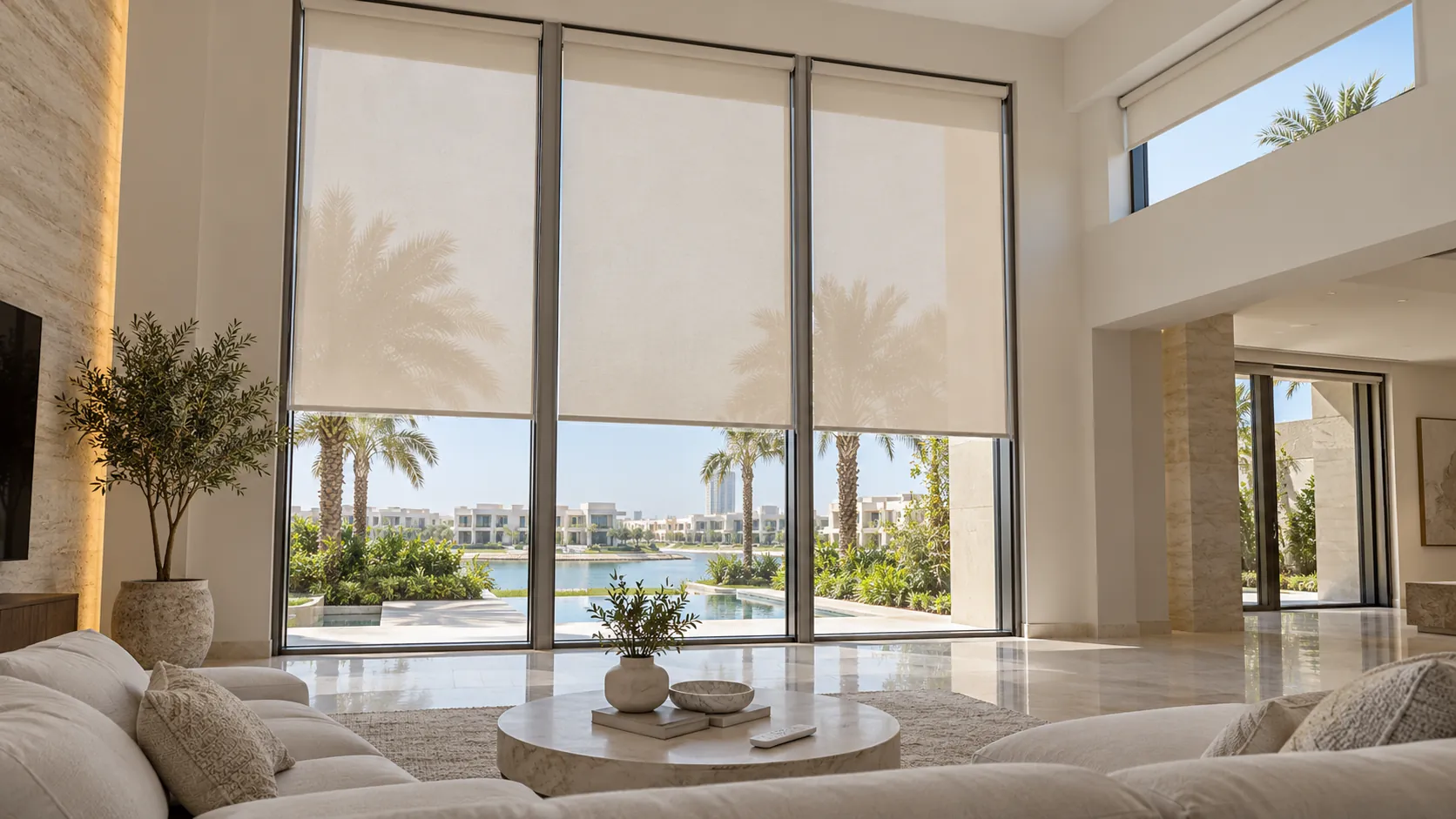
Motorised Blinds for Large & Hard-to-Reach Windows: What Are Your Options?
Compare suitable blinds for wide, high and overhead glazing, and plan size limits, power, controls and maintenance access before installation.
A high window brings daylight into the room, but adjusting its blind means stretching or leaving it in the same position. Across wide glazing, the problem may instead be the effort of moving a large covering. Motorisation can help, but those situations need different specifications.
Blinds for high windows must be practical to operate and maintain. Motorised large blinds also need a suitable fabric, supporting system, drive and fixing arrangement; a stronger motor does not remove every size limit.
This guide compares product, layout, power and control options for Abu Dhabi homes with tall glazing, broad windows and difficult access. It explains when one blind, several smaller units or a specialist system is worth considering, and why charging and future servicing belong in the plan before installation.
Define the access problem before choosing the blind
High, wide and overhead are different applications
A narrow window above a stairwell may be difficult to reach without requiring a heavy-duty blind. A wide living-room window may be accessible but need a system suited to its span and fabric load. A sloping roof window adds another requirement: the covering must work in that orientation.
Do not choose solely by the motor name or the appearance of a fabric sample. Width, drop, fabric weight, mounting depth, handles and the fixing surface all affect the proposed installation.
Manufacturer roller systems have different capabilities. Louvolite's commercial guidance, for example, selects systems around width, drop and fabric weight, rather than giving every roller blind one universal size allowance. [1]
Daily control and maintenance access are separate
A handset may remove the need to reach the blind each day. It does not automatically solve reaching a charging socket, removing a battery pack or gaining access for repair.
That distinction is important above stairs, behind furniture and in high-ceiling villas. A design that looks convenient at handover can become awkward if ordinary maintenance needs an access arrangement nobody planned.
In Abu Dhabi apartments, balcony doors and window handles also need to remain usable. If several products share the glazing, check how the blind, any curtain layer and the opening sections interact.
Set the light-control requirement too
Decide whether the room needs glare reduction, daytime light filtering, evening privacy or stronger darkening. High-level glazing can still be overlooked from another building.
Motorisation changes how a blind moves, not what its fabric does. Open-weave screening does not assure night-time privacy, and blackout fabric does not close every perimeter gap. Assess coverage and fitting separately from powered operation.
Your options: product, layout, power and controls
Motorised roller blinds for suitable vertical glazing
Roller blinds can be a straightforward option for rectangular windows where the selected system suits the dimensions. Fabric winds around a tube, with the drive chosen for the system and load.
For a wide or tall blind, confirm the finished width and drop, fabric availability, roll size, supporting hardware and motor compatibility. The fabric's available width is not the same as a guaranteed finished-blind limit.
Some designs require a different tube or system; others may be better divided into several units. Increasing motor capacity cannot make unavailable fabric wider or remove the supporting system's constraints.
For fabric choices, read The Complete Guide to Roller Blinds in Abu Dhabi.
One wide blind or several smaller blinds?
A single blind offers one continuous fabric panel. It may suit a clean appearance, provided the complete system supports the size and the result meets your coverage needs.
Several blinds can follow window bays or mullions, the dividing members between glazed sections. This can allow individual adjustment, keep some views open and reduce the span of each product.
The trade-off is more hardware and visible divisions. Gaps may remain between adjacent fabric edges; aligning brackets does not make neighbouring blinds a sealed screen. Discuss the gaps before choosing a split arrangement for a bedroom.
Group control may move compatible blinds together, but each still needs its own specification and settings. Do not assume different units will maintain perfectly matching bottom-bar positions throughout travel; discuss the expected behaviour and handover checks.
Other blind styles, selected by the application
Motorised Roman or honeycomb systems may be worth considering where you prefer a softer fabric treatment or a cellular structure. Available dimensions, fabric construction and powered operation depend on the actual product.
For Venetian blinds, establish whether the proposed motor controls slat tilt, raising and lowering, or both. A tilting function alone does not solve the effort of lifting a heavy blind out of the way.
These are options to assess, not a promise that every style can be made to every width or powered with the same motor. Appearance, required operation and maintenance access should be considered together.
Purpose-designed systems for roof or unusual glazing
Overhead and sloping openings need systems intended for that application. Depending on the design, fabric guidance or tensioning keeps the covering positioned; a normal free-hanging vertical blind should not be assumed to work overhead.
Manufacturer fitting guidance distinguishes skylight and free-hanging products, supporting the need to select the correct arrangement rather than treating them as interchangeable. [2]
Shaped or angled windows also need a product-specific assessment. Some suitable systems offer movement; other treatments may be fixed. Ask which part of the glazing can actually be covered and operated.
Choose power around future access
Rechargeable systems can avoid new permanent power provision where the selected product is suitable, but they still need a practical charging method. Confirm whether charging is in place, through an accessible connection or by removing a component.
Do not rely on a generic battery-life figure. Product, size, use and settings affect the arrangement; ask for the actual manufacturer's guidance and how charging will be managed at your window.
Mains-powered or appropriate low-voltage systems may suit installations where repeated charging access would be difficult. They require planned power provision, suitable routing and accessible components. Agree who completes electrical work, using an appropriately qualified contractor for mains work.
Manufacturer ranges can offer rechargeable and mains options, but availability does not establish that both suit your particular blind. [1]
Start with local control, then add automation if useful
A compatible handset or accessible wall control may fully solve the reaching problem. Individual control lets you adjust one bay; grouping can help where several compatible blinds should move together.
App control, schedules, voice commands or sensor-led operation require the relevant system capabilities and sometimes additional equipment. Motorised describes powered movement; smart describes compatible connected functions.
Check the exact motor variant, receiver or interface, hub, platform and functions. Manufacturer integration guidance may require a bridge; Somfy's Gulf SmartThings guidance, for example, uses TaHoma for compatible equipment. [3]
A radio-controlled motor is not necessarily battery-powered, and a wired power supply does not tell you which smart platform works with it. Record both power and control requirements in the specification.
| Option | Useful where | Main limitation to check |
|---|---|---|
| One suitable motorised roller | A continuous panel is preferred | Complete system size, fabric and fixing limits |
| Several separately specified blinds | Glazing has distinct bays or needs individual control | Inter-panel gaps, added hardware and group behaviour |
| Motorised Roman, honeycomb or Venetian | Another style suits the room better | Product-specific sizes and exactly which movements are powered |
| Purpose-designed roof or shaped system | Glazing is overhead, sloping or unusual | Intended orientation, movement and access requirements |
| Retain an existing suitable covering | The product remains sound and a permitted upgrade is feasible | Exact retrofit compatibility and parts support |
Choose the arrangement that solves your actual difficulty
If your priority is adjusting a small high window, consider suitable motorisation with an accessible local control and a clear charging or power plan. A large-capacity system may be unnecessary.
If your priority is operating broad glazing comfortably, compare one suitable blind with a divided layout. Balance appearance, independent shading and gaps with the full specification.
If your priority is shading above a stairwell, prioritise maintenance and service access alongside daily control. Confirm how work at height will be arranged before installation.
If your priority is automated room routines, describe the intended schedule or scene, a coordinated setting for several devices. Ask which hardware and setup are included.
These hypothetical examples need a survey where dimensions, fixing surfaces or access are uncertain. Take photographs of the whole opening and the area below it, not only the glass.
Could the existing blinds stay?
Sometimes a suitable existing product can be upgraded, but its condition, mechanism, tube or headrail and the manufacturer's conversion rules must be checked. A motor is not a universal replacement for a chain.
Manufacturer retrofit guidance can impose product-specific conditions and refer conversion decisions to the original dealer. Those conditions are not universal rules for every brand or a guarantee of UAE availability. [4]
If the blind is catching or damaged, assess repair before motorisation. Use the Maintenance Guides for fault and repair considerations. Retaining a practical existing arrangement can be sensible where powered operation adds little value.
Test the installed system, not just the handset
At handover, check travel and stopping positions, clearances, independent and grouped operation, and the agreed coverage. Ask for a demonstration of charging, permitted user checks and power-cut behaviour; manual operation when power is off is not guaranteed.
If app or automated functions were ordered, test the actual functions with the agreed equipment. Keep a practical local-control plan rather than assuming every command depends on the same network route.
Removing an accessible operating chain can reduce a cord hazard, but assess all retained cords and components. Required safety devices need correct fitting and use; a tensioner does not eliminate every hazard. Keep cots and climbable furniture away from window controls. [5]
For deeper automation planning, explore the Smart Home Guides.
Specification and installation checklist plus FAQs
Nine checks before ordering
- Application: Identify high, wide, overhead or shaped glazing and the required movements.
- Dimensions and material: Confirm finished size, fabric construction and complete system limits.
- Layout: Agree one or several blinds, motor count, fixing positions and expected light gaps.
- Access: Plan installation, cleaning, charging and future service access separately.
- Power: Specify the exact supply and charging arrangement, including electrical responsibilities.
- Controls: Confirm individual operation, grouping and included handsets or switches.
- Connected functions: Verify platform compatibility, hubs/interfaces, accessories and setup scope.
- Testing: Agree stopping positions, coverage, clearance and demonstrations at handover.
- Aftercare: Obtain care guidance, permitted user checks, warranty terms and support arrangements.
Can one motorised blind cover any large window?
No. Width, drop, fabric, supporting system, drive and fixings all impose limits. Ask for a confirmed specification for the actual opening; a split arrangement may be more suitable.
Are battery blinds suitable for hard-to-reach windows?
They can be, if the product suits the application and charging is practical. Check future access before choosing; a remote control solves daily operation but not necessarily battery maintenance.
Do high windows need smart-home automation?
Not necessarily. A suitable local control may be enough. Choose app, scheduling or voice functions where they add useful capability, with compatibility and required equipment confirmed.
Can normal roller blinds be used on a sloping roof window?
Do not assume so. Specify a system intended for the orientation and opening, with appropriate fabric guidance and fixing arrangements.
Can several blinds operate from one control?
Compatible systems may support grouping. Confirm individual control, the required group and expected operation; mixed technologies or different product settings can complicate the plan.
Can I motorise blinds I already own?
Possibly, subject to condition, system design and manufacturer rules. Ask for assessment before buying a motor or removing the current mechanism.
Plan easier operation without overlooking access
Tell Blinds Depot Abu Dhabi about your window dimensions, the reaching difficulty, preferred shading and any existing smart-home equipment. Book a free consultation for professional measuring and tailored recommendations. Ask for the proposed product, size limits, power, controls and maintenance access to be clearly identified before ordering. [6]
Sources
More stories
Are Motorised Blinds Worth It? Costs, Benefits & What to Consider
Yes, motorised blinds can be worth paying more for when motorisation makes the window covering noticeably easier to use.
Motorised Curtains Explained: Tracks, Motors, Weight & Smooth Operation
Understand how curtain load, track layout, power and controls work together, and what to specify for smooth powered operation and suitable automation.
Motorised Blinds for New Builds & Renovations: What Should You Plan Beforehand?
Plan motorised blinds before the finishes are fixed. Understand power choices, controls, recess space and service access, then coordinate the right requirements with your contractors.